Definition
Attaches additional responsibilities to an object dynamically. Decorators provide a flexible alternative to subclassing for extending functionality.
Components
- ComponentBase: base class for all concrete components and decorators.
- ConcreteComponent: inherits from ComponentBase. Concrete component classes that may be wrapped by the decorators.
- DecoratorBase: base class for decorators. It has a constructor that accepts a ComponentsBase as its parameters.
- ConcreteDecorator: It may include some additional methods which extend the functionality of components.
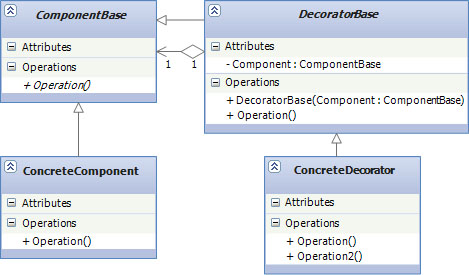
Decorator pattern uml
Sample code
static class Program
{
    static void Main()
    {
        var component = new ConcreteComponent();
        var decorator = new ConcreteDecorator(component);
        decorator.Operation();
    }
}

public abstract class ComponentBase
{
    public abstract void Operation();
}

class ConcreteComponent : ComponentBase
{
    public override void Operation()
    {
        Console.WriteLine("ConcreteComponent.Operation()");
    }
}

public abstract class DecoratorBase : ComponentBase
{
    private readonly ComponentBase _component;

    protected DecoratorBase(ComponentBase component)
    {
        _component = component;
    }

    public override void Operation()
    {
        _component.Operation();
    }
}

public class ConcreteDecorator : DecoratorBase
{
    public ConcreteDecorator(ComponentBase component) : base(component) { }

    public override void Operation()
    {
        base.Operation();
        Console.WriteLine("[ADDITIONAL CODE BLOCK]");
    }
}
Advantages
- It helps to achieve extending the components' functionality by avoiding changing components' original logic.
- It provides a flexible alternative to subclassing for extending functionality, which could change components' behavior at runtime.
Reference
Design Patterns 2 of 3 - Structural Design Patterns - CodeProject
Head First Design Patterns - O'Reilly Media
